
Understanding Nervous System Dysregulation: Why We Freeze, Fight, Flee, or Fawn and How to Find Safety Again
There was a time when I used to freeze before every decision - stuck in place, overthinking every possible consequence. I thought it meant I was indecisive, incapable, or simply not confident enough.
But it wasn't a personality flaw. It was my nervous system trying to protect me. From what it perceived to be a threat.
Our bodies aren't wired for perfection. They are wired for survival.
And when our nervous system detects danger, even when there is no real danger, it activates deeply biological responses that override logic, willpower, and even our intentions.
These responses are the ways our nervous system learnt to protect us. They are ancient survival strategies. Those that kick in even before we can think.
What's Really Happening During a Threat
When we are in any situation, our five senses detect and send this information to the brain. Here the rapid response system of the brain called the limbic system processes this information with only one goal: keeping you alive.
The limbic system is an important structure whose main function is to trigger behaviors that can help us survive. Historically, it helped our ancestors survive by producing natural instincts to eat and drink, reproduce, care for young or react to surroundings.
The limbic system takes in information, processes it, learns from it and reacts. It consists of four main components:
- Thalamus → receives and routes sensory information
- Amygdala → detects threat and assigns emotional meaning
- Hypothalamus → activates the body via hormones
- Hippocampus → stores and retrieves memories
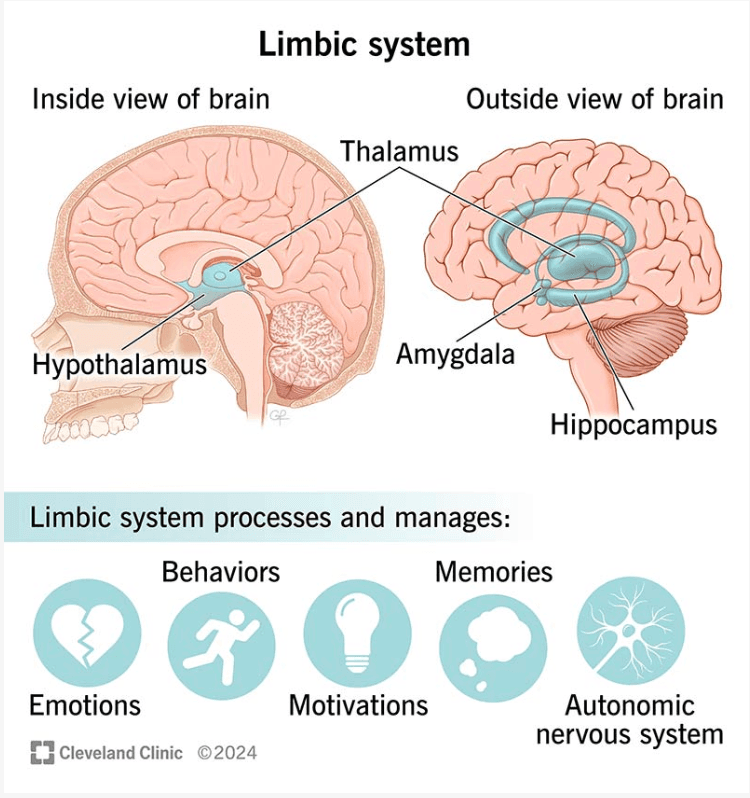
So the Thalamus relays information to the limbic system where the Amygdala scans it for danger.
The Amygdala responds to real or perceived threats (based on past experiences and emotional meanings associated with memories stored in the Hippocampus).
It doesn't just ask if the situation is dangerous, rather looks into past experiences to identify: "Have I felt something like this before... and what helped me survive?"
As a result, the Amygdala doesn't just respond to actual danger but also identifies current non-threatening situations like "tone of a voice", "silence", "closeness with a person" as dangerous depending on similar past experiences of threat.
It triggers the alarm and sends a signal to the Hypothalamus, which then activates the Autonomic Nervous System.
Fight, Flight, Freeze or Fawn - How Do We Respond to Threat
Once the Autonomic Nervous System is activated, it automatically chooses a response/reaction in the face of a threat. This response is reflexive and often subconscious based on past experiences of survival.
The Autonomic Nervous System has two primary branches:
| Sympathetic Nervous System | Parasympathetic Nervous System |
|---|---|
| This is the fight-flight system preparing your body for action. It creates involuntary body activities like: increasing heart rate, speeds up breathing, releasing adrenaline and cortisol, redirects blood to muscles, and sharpens focus. | This controls the rest and digest functions of the body, helping it rest and recover. While naturally aimed to create a calm, grounded, socially engaging state (Ventral Vagal), the system changes into a Dorsal Vagal state in case of an overwhelming or inescapable threat situation — thus creating numbness, disconnection or collapse → freeze response. |
So once the Autonomic Nervous System is activated, the body chooses the most adaptive response based on what feels possible:
| Response | What's happening | Behaviors in real life |
|---|---|---|
| Fight (Sympathetic) | Move toward threat → anger, control, confrontation | Arguing, controlling, irritability, overasserting, forcing solutions |
| Flight (Sympathetic) | Move away from threat → avoidance, escape, overworking, distraction | Avoiding, overworking, distracting, escaping situations, perfectionism |
| Freeze (Parasympathetic - Dorsal Vagal) | When fight or flight is impossible → shutdown, numbness, dissociation | Feeling numb, stuck, dissociated, unable to respond or decide |
| Fawn (Blend: Sympathetic + Ventral Vagal) | Adapting to relational threat → people-pleasing, over-accommodating, losing boundaries | People-pleasing, appeasing, sacrificing your needs for harmony |
Often, in any case of danger or perceived danger, we tend to respond in a default way of Fight-Flight-Freeze-or-Fawn. That's because your nervous system is not reacting to reality here but to a perceived sense of safety based on past learning.
And the important thing to remember here is that it is trying to protect you based on strategies that have worked for you in the past.
Nervous System Dysregulation: What Happens and Why is it so Common Today
Our nervous system is designed to continuously scan for danger and protect us. This process is automatic. And is what helped us survive very real, immediate dangers in the past such as:
- Escaping a predator
- Finding shelter during a storm
- Reacting quickly to something life-threatening.
The body would activate, respond via the Autonomous Nervous System, and then return to a state of rest (Ventral Vagal).
Stress came in waves. And it completed its cycle.
Today, the system hasn't changed. But the world around us has.
The threats we experience today are often subtle, ongoing, and harder to resolve. Some examples being:
- Deadlines that don't end
- Notifications that don't stop
- Relationships that feel uncertain
- Emotional labor that goes unnoticed.
There's no clear moment where the body can say: "It's over. You're safe now."
So the activation doesn't fully switch off.
Rather the system is exposed to stress for a long time due to above reasons or when shaped by earlier experiences like emotional neglect or trauma. As a result, it starts to perceive danger more frequently, even in situations that aren't actually unsafe.
Not because something is wrong with you.
But because your body has learned that staying alert is what keeps you protected.
This is what we call nervous system dysregulation.
It's not a dysfunction.
It's protection that hasn't had a chance to settle.
And often it looks like living in a constant state of:
| Hyperactivation (fight / flight) | Hypoactivation (freeze / shutdown) | Fawn |
|---|---|---|
| Anxiety. Irritability. Restlessness. Overthinking. Difficulty slowing down. Sleep that never feels deep enough. | Numbness. Disconnection. Low energy. Burnout. Finding it hard to feel, respond, or engage. | Over-accommodating. People-pleasing. Losing touch with your own needs to maintain connection. |
But because our culture today glorifies hustle, hyper-independence and emotional suppression, we do not always recognize these states as distress.
We mistake hyperactivation for productivity, shutdown for discipline.
We praise pushing through more than pausing and recovery.
It's only when the body forces a pause — through fatigue, burnout, anxiety, or breakdown — that we realize something is wrong.
Regulating Your Nervous System: Teaching the Body That It Is Safe Again
In order to protect our nervous system from dysregulation, we need to teach our body to feel safe again.
To help it know what safety feels like. When our body is not under stress. When we are in the presence of someone we love and trust. When we are able to pause, rest, connect and live.
Our body needs to be able to recognize when it is under stress, and take steps to regulate and come back to safety.
An important thing to remember here is that regulation is not about being calm all the time. It's about building the ability to move between activation and rest, and return to a place of enough safety. It isn't control, it's flexibility.
Below are some of the ways our body can learn to regulate:
1. Bottom-first Approach - Start with the Body, not the Mind
When the threat system is activated, the thinking brain goes offline. As a result, working with logic alone cannot be of help. The first most important thing to do is help the body notice cues that signal you are not in danger right now.
What can help:
-
Grounding - Put your feet on the floor and feel your weight. Notice colors, textures, temperature. Try the 5-4-3-2-1 technique: 5 things you see, 4 feel, 3 hear, 2 smell, 1 taste. And practice longer exhales. It helps you reorient to the present and have more awareness of your surroundings - thus reducing the perception of threat.
-
Slow, steady breathing - Slow and paced breathing reduce sympathetic overdrive, from going into fight-or-flight. Try box breathing: inhale (count till 4), hold (count till 4), exhale (count till 4), hold (count till 4), and repeat.
-
Gentle movement - Walking, stretching, or small rhythmic movements like tapping or shaking can help discharge the tightness in your body. It helps release unused energy from fight-or-flight arousal. And can be a great aid in shifting from a freeze response to action readiness.
-
Soothing touch - Holding your arms, placing a palm over the heart or feeling the texture of something around you can cue safety through sensory pathways.
These activities engage the body and vagal tone, which can calm the nervous system faster than thinking alone. And once the body starts feeling safe, it can signal safety to the brain "You're safe."
2. Co-regulation - Safety through Connection
A regulated nervous system helps regulate others. Connecting with someone you trust — a therapist, friend, or loved one — can physiologically help calm your body. Their safe presence, calming voice, or attuned conversation can reduce arousal and create a felt sense of safety in your dysregulated nervous system.
So reaching out to someone who you feel safe with, talking or sitting with them or feeling held with them can help you feel settled. You borrow their safety until your body learns it again.
Over time, the body begins to internalize this.
And what was once external support becomes something you can access within.
3. Top-down Approach - Change the meaning in the Mind
Once the body starts to feel safer, the thinking brain comes online and we can use it to regulate ourselves as well.
Start by noticing what is happening in your body, rather than suppressing the sensations you feel. Tightness, heat, tingling, heaviness, fluttering, numbness. Name it: "I notice my chest and neck feels tight". It helps reduce emotional intensity.
Instead of thinking "What's wrong with me?", remind yourself that this is a protective response from your body. Compassion opens the door to regulation. Gently reassure your body that you are safe at this moment.
You may also consider using mindfulness techniques and short grounding meditations at this point, or jot down your reflections in a journal for more clarity and awareness of your patterns.
4. Completing the Stress Cycle
In scenarios where our system is exposed to stress for a long time (such as unending deadlines, non-stop cellphone usage, uncertain relationship dynamics, trauma), the stress cycle never gets completed.
As a result the physiological activation doesn't fully switch off. And lingers in the body.
Completing this stress cycle would look like practicing activities to discharge what the body has been holding. Gentle movements like walking, stretching, shaking; release in the form of crying, deep exhales, yawning; or sighing or humming are some ways to discharge.
Different nervous system responses also tend to hold stress differently in the body. So depending on your dominant response, you can identify the kinds of support or discharge your system may need most.
| Response | How Stress May Show Up | Support That May Help | Ways to Discharge Stress |
|---|---|---|---|
| Fight | Irritability, tension, control, anger, over-functioning | Slowing down before reacting, grounding breathwork, physical release through movement, safe expression of anger | Punching pillow, intense movement, stomping, vocal release |
| Flight | Restlessness, overthinking, busyness, inability to stop | Mindful slowing, journaling, repetitive grounding activities, practicing staying with discomfort in small doses | Walking, shaking, rhythmic movement, longer exhales |
| Freeze | Numbness, shutdown, exhaustion, dissociation | Gentle movement, warmth, sensory stimulation, co-regulation, small achievable actions, reminders of safety | Gentle stretching, warmth, humming, sensory grounding |
| Fawn | People-pleasing, difficulty saying no, abandoning own needs | Boundary work, checking in with personal needs, practicing honest expression, safe relational support | Boundary practice, voice work, expressing unmet needs safely |
Often we are unable to choose our first reaction. But with awareness, we can learn to regulate and choose our next one. Regulation is not about removing these responses but about teaching your body that it is possible to feel safe again.
5. Creating Islands of Safety
Safety starts to feel unfamiliar when our nervous system has been in protection for so long. And our body learns to react rather than respond in stressful situations.
This can be worked with in smaller, repeatable ways:
-
Increasing your capacity to stay present with the stress without getting overwhelmed or shut down. Small moments of noticing without reacting, staying with the sensation for a little longer, and returning to yourself after activation can help build your capacity gradually.
-
Building smaller, repeatable moments of safety in your daily life which help your nervous system remember what safe feels like. A quiet cup of tea, sunlight on your skin, a breath of fresh air, music that softens something inside, a space where you don't have to perform - these are some simple ways to start.
Often, these practices may work best when experienced in the presence of a safe other.
In essence, healing your nervous system isn't about eliminating dysregulation or autonomic responses. It's about expanding your capacity to respond from choice, not just protection. To be able to flexibly move between activation and calm. And it starts from creating a felt sense of safety in your body and mind.
If you're on your journey of healing from dysregulation, know that trauma-informed therapy can help you find safety again — in your body, your emotions, and your everyday life.
Book a free 30-minute Consultation to begin.
References
Dana, D. (2018). The Polyvagal Theory in Therapy.
van der Kolk, B. (2014). The Body Keeps the Score.
Harvard Health Publishing (2023). Understanding the stress response.
McEwen, B. S. (2007). Physiology and neurobiology of stress and adaptation.
Siegel, D. (2012). The Developing Mind.
Porges SW. Orienting in a defensive world: mammalian modifications of our evolutionary heritage. A Polyvagal Theory. Psychophysiology. 1995 Jul;32(4):301-18. doi:10.1111/j.1469-8986.1995.tb01213.x. PubMed
Porges SW. Polyvagal Theory: A Science of Safety. Front Integr Neurosci. 2022. (Open review on Polyvagal Theory and co-regulation). PMC Frontiers
Roelofs K. Freeze for action: neurobiological mechanisms in animal and human freezing. Neurosci Biobehav Rev. 2017. (A clear review of neural mechanisms behind freezing and its functional meaning). PMC
Gerritsen RJS, Band GPH, and others. The Respiratory Vagal Stimulation Model / Breath of Life. (2018). (Review summarizing how slow breathing affects vagal function and physiology.) PMC
StatPearls (NIH/NCBI). Anatomy, Autonomic Nervous System (2023). (Good accessible overview of ANS anatomy and function). NCBI
Yau KKY et al. Effects of diaphragmatic breathing exercises on autonomic function in adults (2021) — study showing diaphragmatic breathing improves autonomic function. ScienceDirect
https://my.clevelandclinic.org/health/body/limbic-system
https://www.simplypsychology.org/fight-flight-freeze-fawn.html